
University City Previous Residents by Era
Previous residents of a University City address leave different kinds of evidence in different eras. A current assessment card anchors the parcel. Recorded instruments can connect transfers, but the official Recorder page did not yield a verified online starting year. Directories show dated listings or subscribers, not every person in a household. Census schedules can identify household members only for the released years. Each source has a separate keeper and a separate limit.
| Source | Years It Covers | Where Held | What It Shows |
|---|---|---|---|
| Recorded instruments | Online starting year not established in official research | St. Louis County Recorder of Deeds | Transfer parties, recording date, book or document reference, and legal description |
| County directories | 1893; 1896; 1903; 1909; 1917; 1920; 1922–23; 1930; 1932; 1934; 1936; 1938–39; 1941; 1943; 1946; 1949; 1953; 1955; 1957–59; 1961–71; 1972–73; 1973–76; 1979 | St. Louis County Library | Listed occupants or subscribers, printed address, and selected household details |
| St. Louis city directories | 1821; 1840; 1842–53; 1864–1942; selected later years through 1980 | St. Louis County Library | City-directory listings and local context, subject to gaps |
| Federal census | Individual schedules through 1950 under the 72-year rule | National Archives and library research routes | Household members, age, relationships, and address-area context where available |
| Sanborn resources | 1909–1951 resource; volume 13, 1924–1950 | Library of Congress and local map collections | Building footprint and street-layout context, after sheet coverage is checked |
For a recent transfer, use the current parcel and Recorder route first. For an early household, start with the selected directory year closest to the period, then pair it with the census. When the address looks unfamiliar, preserve the lot, subdivision, and legal-description details before deciding that it is a different property.
University City Previous Residents Start With Parcels
Before searching backward, freeze the current parcel facts. The St. Louis County Real Estate Search offers Locator Number, Name, Property Address, and Subdivision Name modes. Use the property-address mode for a current street number and name. If the result is ambiguous, the county GIS parcel layer can help locate the polygon and its identifier. Copy the situs address, locator, owner name, mailing address, subdivision or legal description, and any lot or block wording exactly as shown.
The street address is only one key. The situs is the physical location. A tax-mailing address is where bills go and can belong to a trust, estate, entity, or person elsewhere. A legal description may identify a subdivision, lot and block, or another land description that survives a street-number change. The locator is the county bridge between the assessment roll, GIS, and deed work. Those are the facts that keep a previous-residents search tied to one place.
- Parcel or locator
- The county’s structured property identifier. It is more stable than a loosely written address and connects the assessment record to map and Recorder research.
- Situs address
- The physical location assigned to the parcel. It is different from the mailing address on a tax record.
- Legal description
- The recorded land description, often by subdivision, lot, block, or metes and bounds. It is the best continuity check for older deeds.
Note: A present owner or mailing recipient is not automatically a past or present occupant of the University City property.
Trace University City Previous Residents by Deed
The Recorder’s grantor-grantee trail is the ownership backbone for past residents research. Start with the assessed owner and the parcel’s exact legal description. Locate that owner as grantee near the approximate acquisition date, then capture the grantor, grantee, instrument type, recording date, book and page or document number, and legal description. The seller on that deed becomes the person to search as grantee in an earlier acquisition. Confirm the same lot or legal description before joining a name to the parcel.
- Pull the current owner, locator, situs, and legal description from the assessment record.
- Use the official Recorder deed-search page or contact the Recorder with the current owner and approximate purchase date.
- Record the deed’s grantor, grantee, date, instrument number or book and page, and legal description.
- Search the deed’s seller as grantee in an earlier transfer, checking the same legal description or lot and block.
- Repeat until the chain reaches a subdivision, parcel change, or record set that needs counter, microfilm, library, or archive research.
- Grantor
- The person or entity transferring an interest in a recorded instrument.
- Grantee
- The person or entity receiving that interest. In a backward chain, a seller on one deed may be the grantee on an earlier deed.
- Chain of title
- The sequence of recorded transfers for the same parcel. It is tested with the legal description, dates, and instrument details, not a surname alone.
University City Previous Residents Beyond Web Search
The official Recorder landing page is useful, but the interactive deed search was blocked during the research capture. No official online cutoff, exact field list, image availability, or image price was established. Do not assume that every historic deed is online. The practical next steps are the Recorder counter, office research, a deed-copy order, microfilm, and library or state-archive material that can identify an older book and page.
The Recorder deed-copy order form asks for the property address, owner names, approximate purchase date, document type, book and page or document number, copy quantity, certification choice, and requester contact. The documented fee is $2 for the first page, $1 for each additional page, and $1 for certification. Listed postage is $1.50 for up to three documents, $2.50 for three to six, and $3.50 for six to nine. Confirm current counter hours and whether an old book is available at the office before traveling.
That fee schedule is a useful comparison point when a private solicitation resembles a government request. A county copy is tied to a known document and custodian; an unclear offer should be checked against the Recorder’s official contact route at 41 South Central Avenue in Clayton, 314-615-7100.
University City Previous Residents in Directories
Directories turn an ownership trail into a dated household lead. St. Louis County Library holds the county runs listed in the lead table, with gaps that should not be silently filled. The library also holds St. Louis city-directory series: 1821 on microfiche, 1840 in print, 1842–1853 and other early years, a mostly microfilm run from 1864–1942, and selected later print or microfilm years including 1947–48, 1952, 1955–66, 1967–68, 1969–75, 1976–77, and 1980. White and yellow pages survive for some years from 1968–2014.
For a particular University City address, select the closest documented county volume, browse the surname and any address section, and transcribe the entry exactly. Record the directory year, page, printed street form, spouse or relationship notation, occupation or business line, telephone exchange, widow notation, and any abbreviation key. A directory listing is a publication snapshot. It may name a subscriber, principal, or owner rather than every person at the address.
The local collections themselves have their detailed holding notes on the University City City Directory page. For past residents research, use one volume at a time and compare adjacent available years instead of treating a long gap as a move date.
University City Previous Residents in Local History
The St. Louis County Library University City local-history index is another dated lead. It indexes James Lumpp’s 1930 history of University City by surname, first name or initial, page number, and photo reference where available. That is a different kind of evidence from a directory: it can place a person in civic or local-history material, but it does not establish a full street address by itself.
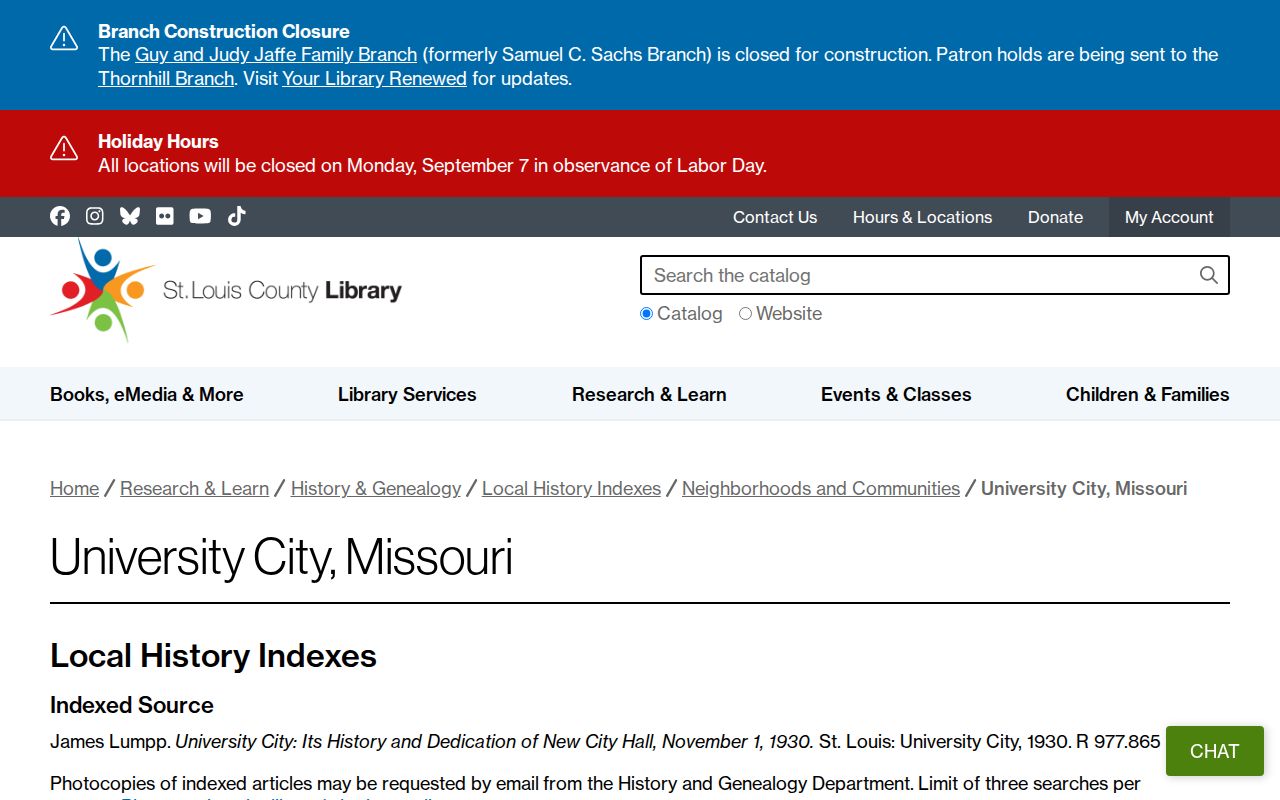
Use a page or photo reference to locate the underlying book, then pair it with a deed, directory, map, newspaper, or census record that supports the address-era connection. SLCL permits up to three searches through its lookup-request route, so a request should include a name and focused subject or page clue.
University City Previous Residents and Census
Directories and the federal census answer different questions. Search the nearest directory first to get the spelling and street form used close to the target year. Then use the census for the appropriate released year to test household members, ages, relationships, and the surrounding enumeration area. The current open individual schedule is 1950. Federal individual schedules after 1950 remain closed under the 72-year rule.
- Choose a documented county or city directory volume near the date in question.
- Transcribe the name, exact printed address, and all entry symbols with the volume and page.
- Check the 1930, 1940, or 1950 census as the period requires, using an enumeration-district route if a name index misses the household.
- Compare street forms, neighbors, age patterns, and spouse or widow notation before treating the entries as one household.
- Use deeds, obituary indexes, or probate records to test a departure, death, or transfer suggested by the dated sources.
The library warns that directory publication dates do not necessarily match a census date. A county directory can also reflect a telephone subscriber rather than everyone in the home. The two sources complement each other, but neither turns a name-only match into proof.
University City Previous Residents and Physical Clues
Maps and permits test the place when the person trail is thin. The Library of Congress lists a St. Louis Sanborn resource spanning 1909–1951 and volume 13 spanning 1924–1950, with University City named as a secondary location. Exact University City sheet numbers were not identified in the research. Check the individual map sheet before saying that it covers a particular property. A map can show street layout or a building footprint, not a list of occupants.
University City Planning and Zoning routes many permit classes through MyGov, including listed electrical, fence, mechanical, plumbing, pool, sewer-lateral, solar, street-use, and water-heater work. Residential and nonresidential building permits are not available online. They must be requested in person or by email through Planning and Zoning, which asks for four paper plan copies for an application. The research found no public permit archive start date, so do not promise a full online house file.
A dated addition, fence, plumbing change, or occupancy permit can help establish that a physical feature existed by a date. It may name an applicant or contractor, but it does not prove that person lived at the address.
Note: Use the parcel legal description when a historic map or permit uses a street form that does not match the modern address.
University City Previous Residents Before 1877
Older research has a jurisdiction trap. The 1877 separation known as the Great Divorce divided St. Louis City and St. Louis County record custody. County records are generally sought at Clayton after that separation, while some earlier city-and-county material may be held with St. Louis City offices or on library microfilm. A researcher who uses only today’s county boundary can miss the historical custody path.
St. Louis County Library holds county-court microfilm identified as SLCCR-1–89 and WPA typescript books 1–23, with the first ten books indexed for 1824–1861. There is no universal surname index for every volume. Treat those sources as historical context, identify a call number or book, and ask the library or archive for the targeted material rather than requesting an undefined name search.
University City Previous Residents Privacy Limits
Previous residents research is strongest when it distinguishes owners, listed occupants, subscribers, heirs, and historical subjects. An old directory or obituary may identify a past connection, but it is not a reason to publish current contact details. Non-owner occupants can be absent from the assessment roll. Court files, vital certificates, protected voter records, and other categories may be closed or redacted even when an older address is known.
Missouri Safe at Home, RSMo §§589.660–589.681, provides an eligible participant with a substitute address for new government and court records. Protected voter and court information can also be absent by law. A missing address is not evidence of a move, and a historic record should never be used to trace or pressure a living person.
Lawful use. Use University City previous residents research for house history, family history, estate questions, and personal curiosity. Do not use an old record to stalk, harass, intimidate, or harm anyone.