
Finding University City Residents
University City sits inside St. Louis County, so a useful search often crosses city, county, and state custodians. Use an address when the question is about a parcel or a former household. Use a full name when checking a public registration or court index. Use a date and an old address when the goal is family history. The county seat is Clayton, where the Recorder, Revenue staff, Circuit Clerk, and many counters are concentrated, while City Hall keeps municipal material.
A record may show an owner, a party to a case, a voter, or a person indexed in a historical volume. Those roles are not interchangeable. Keep the source date with every result, especially when a mailing address differs from the physical parcel or a directory is decades old.
- Enter the address in the St. Louis County Real Estate Search and save the parcel locator, situs, and owner role.
- Use the Missouri voter lookup for a precisely identified registered voter in St. Louis County.
- Check the Recorder’s official deed-search route for a dated transfer, then use the office or copy form if the online result is incomplete.
- For an earlier household, search the St. Louis County Library directory collections by year and address.
- Make a targeted request to the custodian when the needed public record is not online.
University City Resident Records Custodians
County offices hold the principal property and recorded-land trail for University City. The city keeps its own Council, permit, archive, and municipal-court material. The Secretary of State maintains the voter lookup, and the Circuit Clerk keeps county court files. For a street-by-street address chain, the University City streets resource follows the parcel workflow in more detail.
St. Louis County Recorder of Deeds
41 South Central Avenue
Clayton, MO 63105
314-615-7100
St. Louis County Revenue
Property records are county-held in Clayton.
Use the portal for parcel, owner, address, and subdivision modes.
Counter details should be confirmed before a visit.
University City Clerk
6801 Delmar Boulevard, second floor
University City, MO 63130
314-505-8605
Missouri Elections
State lookup, with St. Louis County selected
Protected addresses are excluded.
County procedures and fees need confirmation.
Recorder counter hours appear inconsistently in county material, so call before traveling. That caution also applies to archive holdings, court copies, and any record whose live portal has changed.
University City Residents by Parcel
The county’s Real Estate Search is the strongest current starting point for an address or assessed owner. It offers locator-number, owner-name, property-address, and subdivision-name modes. Choose Property Address for a normal street search. The visible locator field has a strict format and is not a free-form substitute for an address. A result can connect the parcel to a legal description, values, exemptions, mailing address, and map references, although the fields can vary by card.
| Search control | How University City searches use it | Important limit |
|---|---|---|
| Locator Number | Uses the county parcel identifier after a map or card supplies it. | Visible validation allows no spaces and requires a letter in the third position. |
| Name | Finds an assessed owner when the spelling is known. | Dynamic name-match behavior was not fully captured. |
| Property Address | Starts an address-led University City property search. | Use the exact number and street; unit and partial-match behavior need live confirmation. |
| Subdivision Name | Helps when a historic or legal subdivision name is known. | It does not identify every person at an address. |
An assessed owner is not automatically the current occupant. A tax mailing address can be outside University City, and an exemption is an assessment fact, not proof about every person connected to the parcel.
The county property search shows the address, name, locator, and subdivision choices used for University City parcel research.
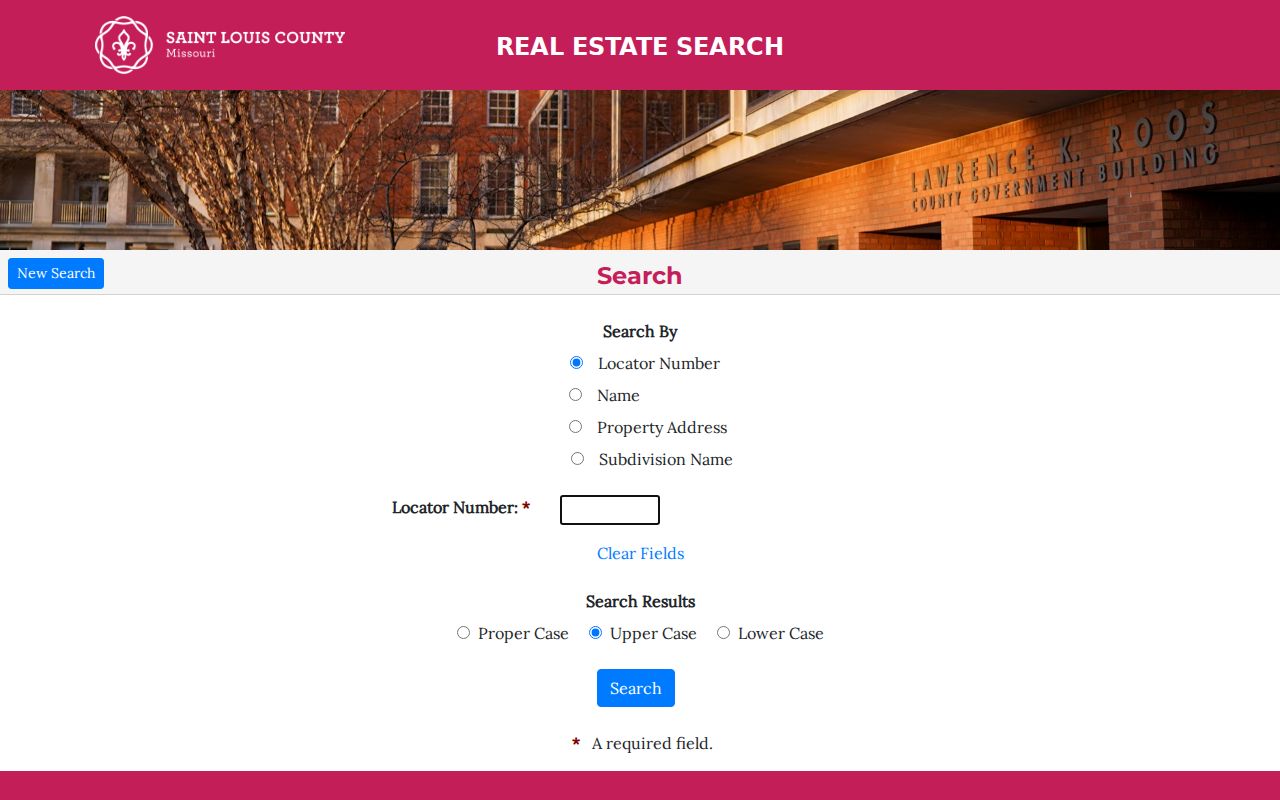
Switching from the default locator mode to Property Address keeps a normal street search from failing on a formatted parcel field.
Note: Preserve both the situs and mailing fields, then label each record by its date and purpose before drawing any conclusion.
University City Resident Record Terms
Records offices use different keys for the same place. Reading those keys correctly prevents a parcel hit from becoming a mistaken claim about a whole household.
- Parcel or locator
- The county identifier that joins an assessment card to GIS and land-record research.
- Situs address
- The physical property address used for the parcel, distinct from where tax correspondence is sent.
- Index
- A finding tool that points to a record. It may not include the underlying image or a certified copy.
- Criss-cross directory
- An address-arranged historical directory that can lead from a printed address to a listed subscriber or occupant.
Use the St. Louis County GIS parcel service to bridge a street segment to a locator, then return to the assessment card. GIS geometry is valuable for the land connection, but its no-warranty notice and parcel-focused data mean it is not a complete people list.
Current University City Resident Directories
No single current directory lists all University City residents. The sources below answer narrower questions, and each has a custodian, date, and privacy boundary. A name that appears in one source should be matched against another independent, dated record.
| University City source | Relationship shown | Custodian | Access route |
|---|---|---|---|
| Real Estate Search | Assessed owner, parcel, situs, and tax-mailing context | St. Louis County Revenue | Free online portal |
| Voter lookup | Limited registered-name and address confirmation | Missouri Secretary of State | Online lookup; protected addresses excluded |
| Recorded instruments | Grantor, grantee, and document trail | Recorder of Deeds | Official search page, counter, or copy order |
| City staff directory | Public city-office contacts | University City | Searchable city directory |
| Community directory | Organization and public contact listings | University City | Category, name, and A–Z search |
The staff and community tools identify public contacts, not private resident rolls. When the goal is one named person, use a University City resident lookup workflow that compares roles and dates.
University City Voter Record Limits
Missouri’s lookup is an identity and registration check, not a universal address directory. Official instructions use first name, last name, house number, street name without the street type, birth date, and the county of current registration. A miss can reflect spelling, a recent move, a timing issue, or an address protected for safety.
RSMo §115.157 describes limited public voter fields, including name, year of birth, address, precinct or district information, and party-affiliation data. It also protects certain addresses and limits commercial use of election-specific information. Ballot choices, Social Security numbers, driver-license data, signatures, and application proof are not public lookup results.
For a broader precinct-register question, RSMo §115.163 allows inspection at reasonable times subject to protected records. Ask the St. Louis County election authority about the current format, appointment process, and fee rather than assuming an online street list exists.
University City Court Names by Date
Missouri Case.net can add a dated court-party check when a name needs independent context. The official portal offers case-number and litigant-name routes. Its name form can use last name, optional first name and date of birth, court or location, and case-type filters. Select the relevant St. Louis County location where the live menu allows it. A case number is the stronger key for asking a clerk about a particular public file.
When public, a result can identify the case number, type, court location, filing date, party role, docket events, hearings, disposition, counsel, or related case. It may not show an underlying document. Sealed, expunged, juvenile, protected-party, and other restricted material is suppressed or redacted. The 21st Circuit Clerk, at 105 South Central Avenue in Clayton, holds county trial files and can explain plain or certified-copy procedures for a known case.
University City Municipal Court uses Case.net for status and has separate local mechanics for citations and parking matters. A case title alone is not a reliable identity match. Compare the party role, date, court, and record type before treating a name as the same person.
University City Deed Names and Dates
The Recorder of Deeds records writings affecting real estate, plats, liens, and other instruments. A deed can place named grantors and grantees in a dated property transfer, but it does not establish present residence. The official search landing page is available, yet its interactive form did not render during research, and no reliable online starting year was located.
The practical fallback is the deed-copy order form or Recorder research. The form asks for an address, owner names, approximate purchase date, document type, book and page or document number, and copy choice. Older books, microfilm, and library sources may be necessary. A plain copy costs $2 for the first page and $1 for each additional page; certification adds $1, with listed postage tiers.
A land trail works from a current grantee to an earlier grantor while checking the same legal description. A similar street number alone is weaker than the parcel and lot or block description.
University City Names in Municipal Records
City Hall holds a different layer of University City material. The City Clerk is the records custodian for the Council journal, ordinances, resolutions, and proclamations. The City Archive Center has category, keyword, archive, time-period, and date-range controls. A name or street can be searched in agendas, CityScape, news releases, and related material.
Planning and Zoning adds address-keyed permit evidence. MyGov supports several online application and tracking routes, but residential and nonresidential building permits require an in-person or email route through the city. Ask for an exact situs address and date range. A permit can identify work, an applicant, or a reviewer relationship. It is not a complete history of everyone at the address.
University City Municipal Court routes case status through Case.net, while underlying materials and certified dispositions belong with the court clerk. The city’s public directories are useful for reaching the correct counter, not for identifying private households.
University City Historical Directory Clues
Historical residents are best approached through the St. Louis County Library’s History & Genealogy collection. It holds county and city directories, telephone books, newspapers, maps, yearbooks, burial material, local indexes, and microfilm. The library’s digitized county directories are free to search or browse, and the lookup service is a documented alternative when an in-person visit is not possible.
Directory results are dated editorial snapshots. They can show a printed name, address, occupation, spouse notation, telephone, or an abbreviation chosen by that volume’s publisher. Browse alphabetical pages when OCR misses a surname, and read the abbreviation key before interpreting a mark. The full shelf, years, and tracing method are kept on the University City city directory page.
University City Growth in the Records
University City’s planned development helps explain why the historical trail uses maps, directories, civic files, and land records together. E.G. Lewis acquired 85 acres in 1902, began the publishing headquarters in 1903, and the Magazine Building later became City Hall. The city incorporated in 1906 after development around features including the beacon, Lion Gates, and the Art Academy.
The 1920 census counted 6,702 residents, and the 1930 count was 25,809 after more than 19,000 people moved in during the decade. That rapid growth makes the 1920s county directories, the 1930 local-history book, newspaper material, plats, and census schedules useful companions. The SLCL index for James Lumpp’s 1930 University City history can point to a name, page, and sometimes a photo reference, even when it supplies no address.
Note: A historical index establishes a printed reference or civic context, not a present-day address or family relationship.
University City Requests and Privacy
When a public record is not online, direct a narrow request to the office that keeps it. Missouri’s Sunshine Law, RSMo §§610.010–610.028, requires a public body to respond as soon as possible and no later than the end of the third business day under §610.023. A request should state the record type, date span, name, address, and preferred inspection or copy format. Under §610.026, a custodian may provide an estimate before copying.
Some records remain restricted regardless of a request. Vital records use separate eligibility rules, court files can be sealed or redacted, DMV personal information is protected, and Missouri Safe at Home provides a substitute address for eligible participants. Missing information is not proof that a person moved or that a record does not exist.
Lawful personal research. Use University City public records for legitimate personal, family-history, civic, or property questions. Never use an address or record to stalk, harass, intimidate, or harm another person.
Historical University City Resident Directories
SLCL documents St. Louis County directory runs from 1893 through 1979 with real gaps, plus city-directory holdings that begin with 1821 microfiche and continue through uneven later volumes. Missouri Digital Heritage adds digitized St. Louis directories and Blue Books from 1872 to 1900. For an older address, search the specific year, browse where OCR falls short, then pair the entry with a deed, census schedule, obituary, or local-history source.
Historical jurisdiction matters as well. Before the 1877 separation often called the Great Divorce, St. Louis city and county material can overlap. Later county trails generally lead to Clayton. A failed online search is a reason to identify the right volume, microfilm reel, archive request, or counter, not a reason to assume the history is gone.
The Missouri State Archives County and Municipal Records Database is another fallback for a defined historical series. Its catalog can be searched by county, office type, record type, keyword, city, and year range. A research request needs a county and a concrete record description. Give the office, date span, names or keywords, and a legal description when land is involved instead of asking for every record associated with an address.