
Finding University City Residents
University City sits inside St. Louis County, so a thorough search crosses city, county, and state custodians. Match the tool to the question. An address suits a parcel or former-household query. A full name fits a registration or court index. Add a date and an old address for family history. Clayton serves as the county seat, and its offices concentrate the Recorder, Revenue staff, Circuit Clerk, and many counters in one place. City Hall keeps the municipal material. One record may show an owner, a court party, a voter, or a name in a historical volume. Those roles are not interchangeable. Keep the source date with every result, because a mailing address can differ from the physical parcel or a directory can be decades old.
- Enter the address in the St. Louis County Real Estate Search and save the parcel locator, situs, and owner role.
- Use the Missouri voter lookup for a precisely identified registered voter in St. Louis County.
- Check the Recorder’s official deed-search route for a dated transfer, then use the office or copy form if the online result is incomplete.
- For an earlier household, search the St. Louis County Library directory collections by year and address.
- Make a targeted request to the custodian when the needed public record is not online.
University City Resident Records Custodians
The county holds University City's property and land trail. Deeds, assessor rolls, and recorder records answer there. City Hall keeps Council, permit, archive, and municipal-court material, while the Secretary of State maintains the voter lookup and the Circuit Clerk keeps county court files. For a street-by-street address chain, the University City streets resource follows the parcel workflow in more detail.
St. Louis County Recorder of Deeds
41 South Central Avenue
Clayton, MO 63105
314-615-7100
St. Louis County Revenue
Property records are county-held in Clayton.
Use the portal for parcel, owner, address, and subdivision modes.
Counter details should be confirmed before a visit.
University City Clerk
6801 Delmar Boulevard, second floor
University City, MO 63130
314-505-8605
Missouri Elections
State lookup, with St. Louis County selected
Protected addresses are excluded.
County procedures and fees need confirmation.
Recorder counter hours appear inconsistently in county material. Call ahead before traveling, and apply the same caution to archive holdings, court copies, and any record whose live portal has changed.
University City Residents by Parcel
The county's Real Estate Search is the strongest starting point for a current address. It also works well for an assessed owner. Four search modes are offered. Owner name and subdivision name each get their own mode. Pick Property Address for a normal street search. The locator field demands a strict format. It cannot stand in for a free-form address. A result can tie the parcel to a legal description, values, exemptions, a mailing address, and map references. The fields vary by card.
| Search control | How University City searches use it | Important limit |
|---|---|---|
| Locator Number | Uses the county parcel identifier after a map or card supplies it. | Visible validation allows no spaces and requires a letter in the third position. |
| Name | Finds an assessed owner when the spelling is known. | Dynamic name-match behavior was not fully captured. |
| Property Address | Starts an address-led University City property search. | Use the exact number and street; unit and partial-match behavior need live confirmation. |
| Subdivision Name | Helps when a historic or legal subdivision name is known. | It does not identify every person at an address. |
An assessed owner is not automatically the occupant. That gap trips up many lookups. A tax mailing address can sit outside University City, and an exemption is an assessment fact, not proof about every person tied to the parcel. The county property search shows the address, name, locator, and subdivision choices used for University City parcel research.
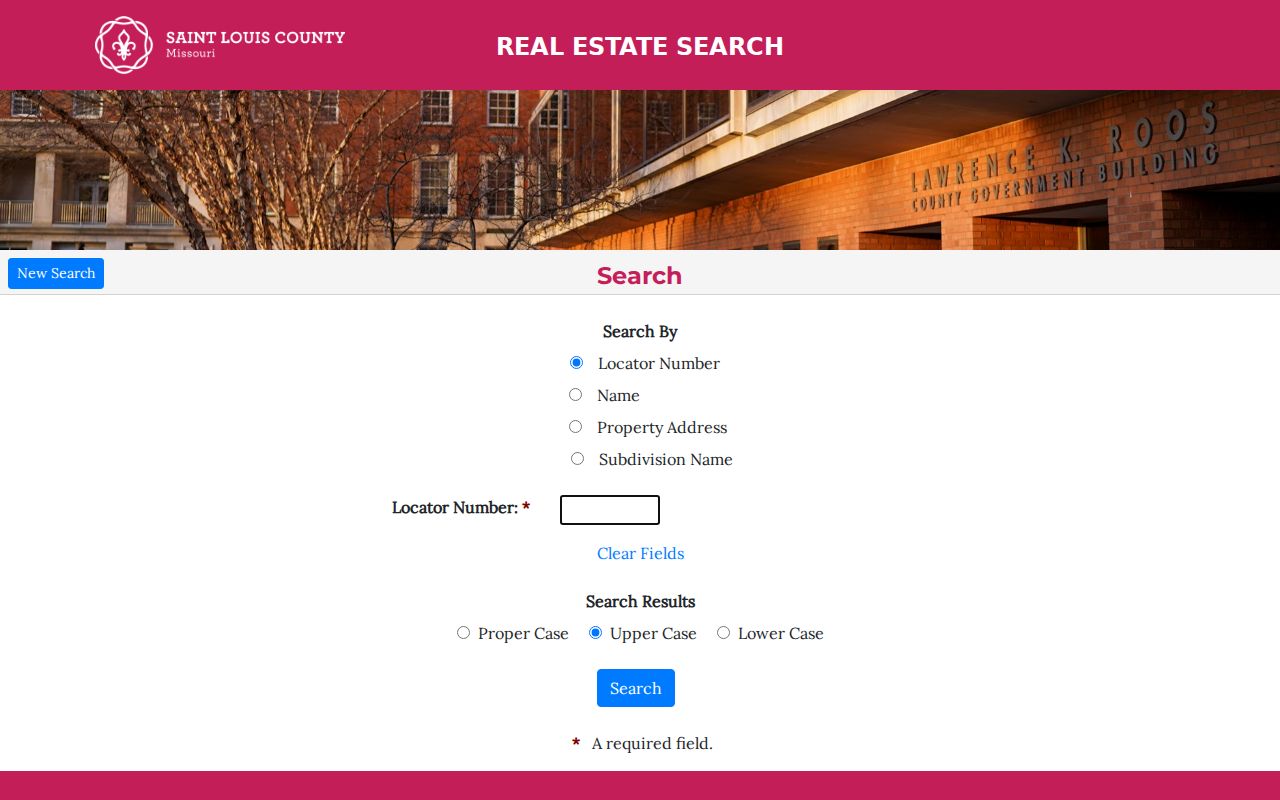
The default locator mode rejects plain street addresses. Switching to Property Address mode fixes that. Note: Preserve both the situs and mailing fields, then label each record by its date and purpose before drawing any conclusion.
University City Resident Record Terms
Records offices use different keys for the same place. Reading those keys correctly keeps a parcel hit from turning into a mistaken claim about a whole household.
- Parcel or locator
- The county identifier that joins an assessment card to GIS and land-record research.
- Situs address
- The physical property address used for the parcel, distinct from where tax correspondence is sent.
- Index
- A finding tool that points to a record. It may not include the underlying image or a certified copy.
- Criss-cross directory
- An address-arranged historical directory that can lead from a printed address to a listed subscriber or occupant.
The St. Louis County GIS parcel service bridges a street segment to a locator number. From there, return to the assessment card. GIS geometry is valuable for the land connection. Its no-warranty notice and parcel-focused data mean it is not a complete people list, so treat it as one layer of a University City residents directory search rather than the whole answer.
Current University City Resident Directories
No single current directory lists all University City residents. Each source answers a narrower question. Every one has its own custodian, date, and privacy boundary, so match a name from one source against another independent, dated record before trusting it.
| University City source | Relationship shown | Custodian | Access route |
|---|---|---|---|
| Real Estate Search | Assessed owner, parcel, situs, and tax-mailing context | St. Louis County Revenue | Free online portal |
| Voter lookup | Limited registered-name and address confirmation | Missouri Secretary of State | Online lookup; protected addresses excluded |
| Recorded instruments | Grantor, grantee, and document trail | Recorder of Deeds | Official search page, counter, or copy order |
| City staff directory | Public city-office contacts | University City | Searchable city directory |
| Community directory | Organization and public contact listings | University City | Category, name, and A–Z search |
Community tools surface public contacts, not resident rolls. For one named person, a University City resident lookup workflow compares roles and dates across independent, dated records.
University City Voter Record Limits
Missouri's lookup verifies identity and registration, not a universal address directory. The entry fields are narrow. Official instructions request a first name, last name, house number, and street name. The street type is left out. Birth date and county of current registration finish the query. A miss can mean a spelling problem, a recent move, timing, or an address protected for safety. RSMo §115.157 limits the public voter fields. Name, year of birth, address, precinct or district details, and party-affiliation data may be released. The statute also protects certain addresses. It limits commercial use of election-specific information. Ballot choices stay private. So do Social Security numbers, driver-license data, signatures, and application proof.
For a broader precinct-register question, RSMo §115.163 allows inspection at reasonable times. Protected records stay exempt. Ask the St. Louis County election authority about the current format, appointment process, and fee rather than assuming an online street list exists.
University City Court Names by Date
Missouri Case.net adds a dated court-party layer when a name needs independent context. The portal accepts either a case number or a litigant name. Its name form takes a last name. It also takes an optional first name and date of birth, plus court, location, and case-type filters. Choose the relevant St. Louis County location when the menu allows it. For one known file, a case number remains the stronger key. Hand it to a clerk and the request moves faster.
A public result can list the case number, type, court location, filing date, and party role. It can also show docket events, hearings, dispositions, counsel, and related cases. The underlying document itself often stays off-screen. Sealed, expunged, juvenile, and protected-party material is suppressed or redacted. The 21st Circuit Clerk, at 105 South Central Avenue in Clayton, holds county trial files. The office can walk through plain and certified-copy procedures for a known case.
University City Municipal Court posts status on Case.net. It handles citations and parking matters through its own local mechanics. One caution applies. A matching case title is not a matching person. Compare party role, dates, court, and record type. Only then treat a name hit as the same individual in a University City residents directory search.
University City Deed Names and Dates
The Recorder of Deeds records writings affecting real estate, plats, liens, and other instruments. A deed can place named grantors and grantees in a dated property transfer. It cannot establish present residence. The county's official search landing page exists. The interactive form does not render reliably. The county also publishes no dependable online starting year.
The practical fallback is the deed-copy order form or Recorder research. The form asks for an address, owner names, an approximate purchase date, document type, book and page or document number, and a copy choice. Older books, microfilm, and library sources may be necessary. A plain copy costs $2 for the first page and $1 for each additional page. Certification adds $1, with listed postage tiers.
Trace land from a current grantee back to an earlier grantor. Check the same legal description at each step. A matching street number alone is weaker than the parcel and lot or block description.
University City Names in Municipal Records
City Hall holds a different layer of University City material. The City Clerk keeps the Council journal, ordinances, resolutions, and proclamations. The City Archive Center offers category, keyword, archive, time-period, and date-range controls. A name or street can be searched across agendas, CityScape, news releases, and related material.
Planning and Zoning adds address-keyed permit evidence. MyGov supports several online application and tracking routes. Residential and nonresidential building permits still require an in-person or email route through the city. Ask for an exact situs address and date range. A permit can identify work, an applicant, or a reviewer relationship. It is not a complete history of everyone at the address.
Municipal Court routes case status through Case.net. Underlying materials and certified dispositions belong with the court clerk. The city's public directories help a resident reach the right counter. They do not identify private households.
University City Historical Directory Clues
For historical residents, start with the St. Louis County Library's History & Genealogy collection. It holds county and city directories, telephone books, newspapers, maps, yearbooks, burial material, local indexes, and microfilm. The digitized county directories are free to search or browse. When a visit is not possible, the lookup service is a documented alternative.
Treat directory results as dated editorial snapshots. A printed name may come with an address, occupation, spouse notation, telephone, or an abbreviation chosen by that volume's publisher. Browse the alphabetical pages when OCR misses a surname. Read the abbreviation key before interpreting any mark. The full shelf, the years, and the tracing method sit on the University City city directory page.
University City Growth in the Records
University City's planned development explains the historical trail. It braids maps, directories, civic files, and land records together. E.G. Lewis acquired 85 acres in 1902. He began the publishing headquarters in 1903, and the Magazine Building later became City Hall. Development grew around the beacon, Lion Gates, and the Art Academy. The city incorporated in 1906.
The 1920 census counted 6,702 residents. By 1930 the count reached 25,809. More than 19,000 people moved in during the decade. That surge makes the 1920s county directories useful companions to the 1930 local-history book, newspaper material, plats, and census schedules. The SLCL index for James Lumpp's 1930 University City history can point to a name and a page. It sometimes offers a photo reference, even without an address.
Note: A historical index establishes a printed reference or civic context, not a present-day address or family relationship.
University City Requests and Privacy
When a public record is not online, send a narrow request to the office that keeps it. Missouri's Sunshine Law, RSMo §§610.010–610.028, sets the timeline. A public body must respond as soon as possible. The deadline is the end of the third business day under §610.023. State the record type, date span, name, and address in the request. Also say whether you want to inspect or receive a copy. Under §610.026, a custodian may give you an estimate before copying.
Some records stay restricted no matter how a request is worded. Vital records follow separate eligibility rules. Court files can be sealed or redacted. DMV personal information is protected. Missouri Safe at Home gives eligible participants a substitute address. Missing information proves nothing about a move or a record's existence.
Lawful personal research. Use University City public records for legitimate personal, family-history, civic, or property questions. Never use an address or record to stalk, harass, intimidate, or harm another person.
Historical University City Resident Directories
The St. Louis County Library charts University City and its neighbors through a long stretch of city-directory history. County directory runs cover 1893 through 1979, though real gaps interrupt the series. City-directory holdings reach back further, starting with 1821 microfiche and continuing in uneven later volumes. Missouri Digital Heritage fills in another era, offering digitized St. Louis directories and Blue Books from 1872 to 1900. Chasing an older address works best when you search the specific year first. Browse the pages where OCR falls short. Then pair whatever entry you find with a deed, census schedule, obituary, or local-history source.
Jurisdiction matters in this region. Before the 1877 split often called the Great Divorce, St. Louis city and county records can overlap in confusing ways. County trails after that date generally lead to Clayton. So a failed online search is really a prompt. Identify the right volume, microfilm reel, or archive request. The history has not vanished.
The Missouri State Archives County and Municipal Records Database offers one more fallback. It covers a defined historical series. You can search its catalog by county, office type, record type, keyword, city, and year range. A research request should name the county and describe the record concretely. Include the office, the date span, and any names or keywords. Add a legal description when land is involved. Avoid asking for every record tied to an address.